
I subscribe to a handful of DTC skincare and home brands every month to see what lands in the inbox when someone signs up for the first time. It’s the easiest way to understand how a brand thinks about its new subscribers, before anyone has spent a dollar.
Canopy is a UK-based brand making “quietly considered essentials for skin, home, and everyday ritual.” That line alone tells you something about the brand they’re trying to be. Calm, intentional, a little understated. The kind of brand you’d expect to feel considered in every touchpoint.
So when their welcome email landed, I read it with that promise in mind.
What Canopy Sent
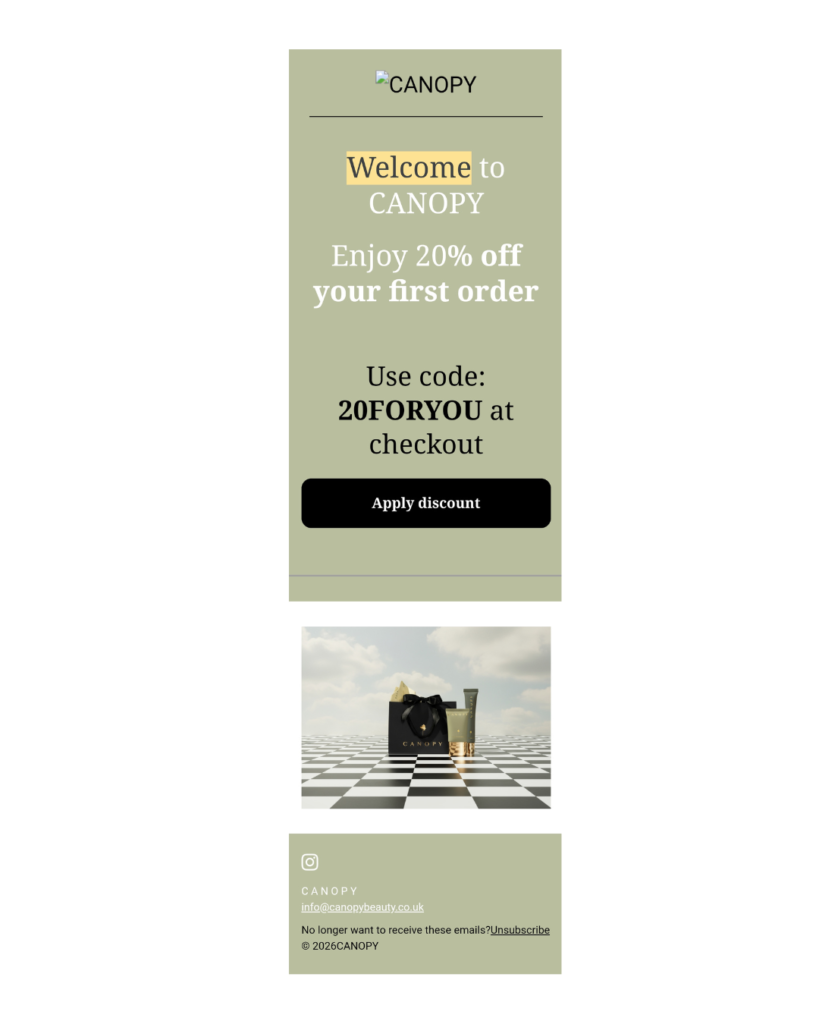
The subject line reads “Welcome to Canopy — Enjoy 20% off your first order.” Open it, and the first thing you see is “Welcome”, followed by “Enjoy 20% off your first order” in large type. Below that, the discount code, and a single button: Apply discount.
Underneath, there’s one product image. A gift bag and a tube of something, staged on a black and white checkerboard floor. There are no names, links, or any context for what’s in the photo.
Then the footer with social icon, unsubscribe link, and copyright.
That’s the entire email.
What’s Missing
The original email never really answers why the brand exists, what makes it emotionally distinct, what kind of lifestyle it represents, or why a customer should remember Canopy specifically.
For a brand built on the idea of considered, quiet ritual, this email doesn’t feel considered. It feels like a template with the brand name dropped in.
A new subscriber learns exactly one thing from this email: Canopy is 20% off right now. They don’t learn what the brand stands for, who’s behind it, what to buy first, or why anyone trusts this brand with their skin or their home. The product image shows something, but doesn’t tell the subscriber what it is or how to get it.
For a brand at this price point, that’s a missed moment. The welcome email is the highest-attention email a subscriber will ever give you. This one spends that attention entirely on a coupon code.
What I’d Send Instead
Here’s the email I’d build if I were hired to run Canopy’s flows.
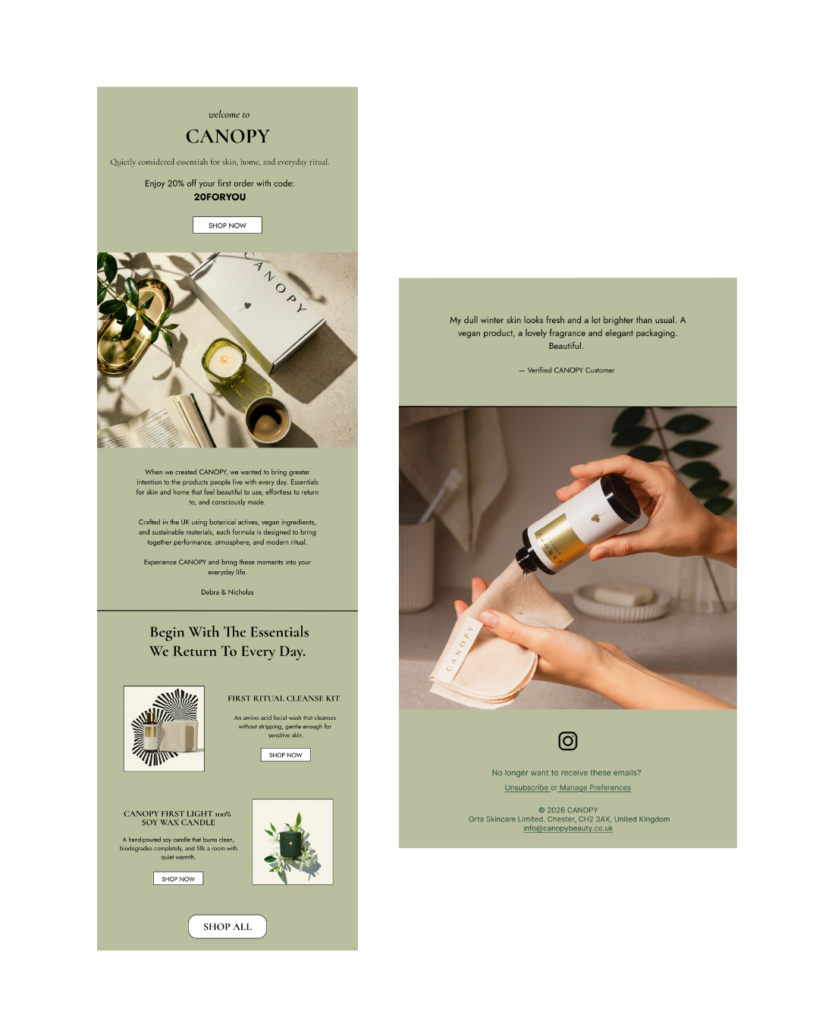
The header still leads with welcome, but the first line subscribers read is the brand’s actual positioning: “Quietly considered essentials for skin, home, and everyday ritual.” The 20% discount is still there, right below it, but it’s support, not the headline.
Below the hero, a lifestyle image that actually reflects the brand’s world. A candle, an open book, a cup of coffee, soft natural light. This is the “everyday ritual” the brand talks about, shown rather than just stated.
Then, a short brand story. Two or three sentences on why Canopy exists, what it’s made from, where it’s made. Signed by the founders, Debra and Nicholas.
After that, a section titled “Begin With The Essentials We Return To Every Day,” featuring two specific products with their own descriptions and “Shop Now” buttons. A new subscriber doesn’t have to guess what to buy. They’re shown a starting point.
Then a single customer testimonial, placed right where a new subscriber’s doubt would naturally surface: does this actually work?
The email closes with a “Shop All” button and the standard footer.
Why These Changes Matter, Not Just Look Better
It would be easy to call this version “nicer” and leave it there, but the differences aren’t cosmetic. Each one changes what the subscriber believes, and what they do next.
1) Leading with positioning instead of the discount changes what the brand means to a new subscriber. An email that opens with a coupon code teaches subscribers to wait for discounts before buying. An email that opens with what the brand stands for builds a relationship first, and offers the discount as a bonus rather than the headline. That difference compounds across every email that follows in the flow.
2) The founder signature does quiet but real work. A brand becomes a coupon code and a logo, or it becomes two people who made something with intention. For a brand asking customers to trust their skin and their home to a relatively unknown name, that’s not a small thing.
3) The curated product section removes a decision a new subscriber shouldn’t have to make alone. Canopy’s original email shows a product with no name and no link. Mine tells the subscriber exactly where to start, with two products that represent the brand well. Fewer decisions between interest and purchase means a better chance that interest turns into a sale, right when it’s highest.
4) The testimonial addresses the one question every new subscriber has and never says out loud. Beautiful branding is not the same as proof that something works. One honest sentence from a real customer, placed at the right moment, does more for conversion than another paragraph of brand copy.
None of this is about making the email prettier. It’s about what a subscriber believes about Canopy in the first thirty seconds of opening their inbox, and what they’re likely to do because of it.
What This Means for Revenue
It’s tempting to file all of this under “better branding” and move on, but a founder looking at this should be thinking about numbers, not aesthetics. So here’s where each change shows up on a P&L.
Discount-led emails train discount-seeking customers.
When the first thing a subscriber learns about a brand is its discount code, that becomes the baseline expectation for every future purchase. Subscribers wait for the next sale instead of buying at full price. Over a year of email sends, that habit shows up as a lower average order value and thinner margins on repeat purchases, the opposite of what a welcome flow should be building.
A curated starting point shortens the path to the first purchase.
Email one is the highest-intent moment a subscriber will ever have. If they have to leave the email, land on a homepage, and decide what to buy on their own, a large share of that intent is lost to indecision. Pointing directly at two specific products with working links converts more of that initial interest into an actual order, while that interest is still warm.
A testimonial at the right moment removes a reason not to buy.
New subscribers are still deciding whether this brand is worth their money. An unanswered “does this actually work” is a silent reason to close the tab. One sentence of social proof, placed where that doubt naturally arises, recovers some of that hesitation directly into conversions.
Brand-first positioning protects long-term value, not just this email.
A welcome flow isn’t one email, it’s the first impression for every email that follows. If email one teaches a subscriber that this brand is a coupon, every later email asking for a full-price purchase is working against that first impression. If email one teaches a subscriber what the brand stands for, every later email is building on it.
None of this requires new traffic, new ad spend, or a redesign of the website. It’s the same subscriber, the same first email, doing more with the attention it already has. That’s usually where the easiest revenue in an email program is sitting, and it’s often the most overlooked.
A Note on This Series
This teardown isn’t paid for, and Canopy didn’t ask for it. I do this because it’s how I think, and because it’s the clearest way I know to show what I’d actually do with a brand’s email program, rather than just describe it.
All images and branding belonging to Canopy are the property of Canopy and are used here for educational and illustrative purposes only. This piece is not affiliated with or endorsed by Canopy.
If you’re a founder running a DTC skincare or haircare brand and your welcome email looks closer to the first version than the second, I’d be glad to talk through what a stronger one could look like for your brand specifically.